
1
Chapter 7
The Silk Road and Beyond:
The Art of Early China and Korea
Gardner’s Art Through the Ages,12e

2

3
Neolithic China:
•China is the only continuing civilization originating in the ancientworld
•The Chinese archaeological record, extraordinarily rich, goesback to Neolithic times, providing evidence of settled village lifeas far back as the seventh or sixth millennium BCE (6000 -5000BCE)
4
Figure 7-1 Yangshao Culture vases,from Gansu Province, China, midthird millennium BCE.Earthenware.
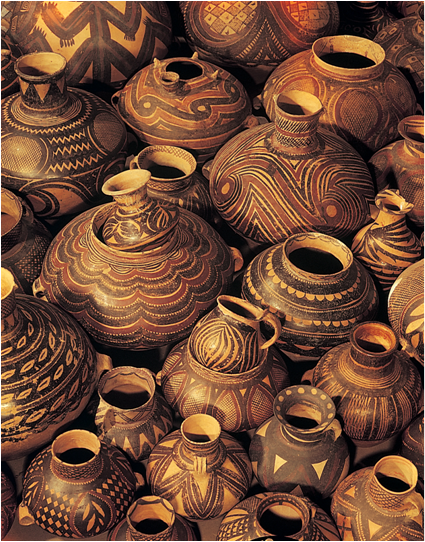
•Yangshao pottery:
•Yangshao civilization emergedalong the Yellow River innortheastern China
•produced finely decoratedearthenware bowls even beforethe invention of the potter's wheel
•most were found in graves
5
Figure 7-1 Yangshao Culturevases, from Gansu Province,China, mid third millenniumBCE. Earthenware.
Yangshao pottery:
•Earthenware: Pottery madefrom a porous clay that isfired at relatively lowtemperatures
•The surface decorationeffectively integrates avariety of angular andcurvilinear geometric motifs
6
Shang Dynasty China:
•1600 – 1050 BCE
•The first great Dynasty of the Bronze Age
•Anyang = the last Shang capital
•Anyang excavation revealed turtle shells, bones and bronzes withthe earliest recordings of Chinese language
•The Shang kings had lavish burials: objects of jade, ivory,lacquer, turquoise and bronze adorned their tombs
•Lacquer: a varnish like substance made from the sap of theAsiatic sumac, used to decorate wood furniture and other objects
7
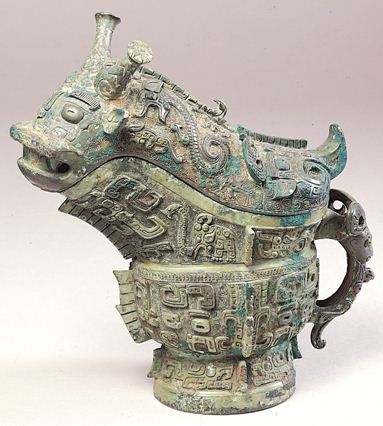
Figure 7-2 Guang, probably from Anyang, China, Shang dynasty, twelfthor eleventh century BCE. Bronze, 6 1/2” high. Asian Art Museum of SanFrancisco, San Francisco (Avery Brundage Collection).
Shang Dynasty
•guang –
libation vessel
•Used in funeral ceremoniesand sacrifice rituals forancestors
•Shang decorative vocabularyincludes abstracted animalmotifs
8
Figure 7-2 Guang, probably from Anyang, China, Shang dynasty, twelfthor eleventh century BCE. Bronze, 6 1/2” high. Asian Art Museum of SanFrancisco, San Francisco (Avery Brundage Collection).
Shang Dynasty
•Rounded square spirals arealso typical on Shang bronzes
•Fish, birds, elephants, rabbitsand composite creatures coverthe vessel
•The animals are probablyconnected with the world ofspirits addressed in the rituals
9
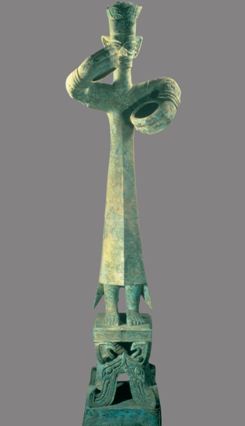
Figure 7-3 Standing figure, from Sanxingdui, China, ca. 1200–1050 BCE.Bronze, 8’ 5” high, including base. China Cultural Relics PromotionalCenter, Beijing.
from Sanxingdui
•At the same time as the Shang, the people ofSanxingdui were also working withbronze…
•The gold, jade and bronze at Chengdureveal that the Sanxingdui were verywealthy and independent from the Shang
•This sculpture is the most dramaticexample of the art of Sanxingdui at over 8feet tall
10
Figure 7-3 Standing figure, from Sanxingdui, China, ca. 1200–1050 BCE.Bronze, 8’ 5” high, including base. China Cultural Relics PromotionalCenter, Beijing.
from Sanxingdui
•This figure is of unknown identity
•It is highly stylized with elongatedproportions and large, staring eyes…
•The four legs of the stand are fantasticanimal heads with horns and trunk-likesnouts
•The figure tapers gently as it rises
11
Figure 7-3 Standing figure, from Sanxingdui, China, ca. 1200–1050 BCE.Bronze, 8’ 5” high, including base. China Cultural Relics PromotionalCenter, Beijing.
from Sanxingdui
•The arms reach out dramatically
•The giant hands once held something
•Representations of the human figure on thisscale and in this period are otherwiseunknown
•Surface decorations include rounded,square spirals, similar to the Shang bronzes
•This was only discovered in 1986
12
Zhou and Eastern Zhou Dynasties in China:
•Zhou = 1050 – 771 BCE
•Eastern Zhou = 770 – 256 BCE
•Longest lasting dynasty in China’s history
•The dividing event is the relocation of the capital from Xi’an(formerly Chang’an) in the West to Luoyang in the East
•475 – 221 BCE is known as the Warring States Period
•In 221 BCE, the state of Qin finally defeated the Zhou
13
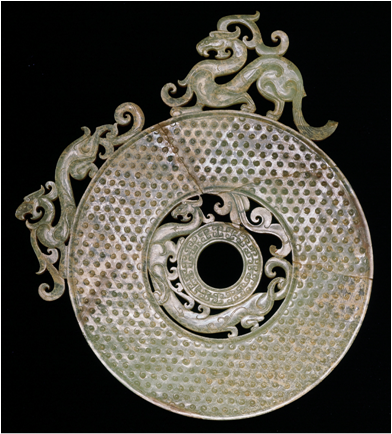
Figure 7-4 Bi (disk), from Jincun(?), China, Eastern Zhou dynasty, fourthto third century BCE. Nephrite, 6 1/2” in diameter. Nelson-AtkinsMuseum of Art, Kansas City.
Zhou Dynasty
•Jade carving reached thepeak of technical perfectionduring the Zhou dynasty
•Bi-disk: thin, flat, circularpieces of jade with a hole inthe center, which may havesymbolized the circle ofheaven
•Rows of raised spiralsdecorate the surface
14
Figure 7-4 Bi (disk), from Jincun(?), China, Eastern Zhou dynasty, fourthto third century BCE. Nephrite, 6 1/2” in diameter. Nelson-AtkinsMuseum of Art, Kansas City.
Zhou Dynasty
•It took incredibly laboriousgrinding and polishing tocarve the jade
•The dragons are especiallyelegant, showing the great skillof this Zhou master sculptor
•Dragons = symbols of goodfortune (live in the water andfly between heaven and earth,bringing rain…)
15
Figure 7-4 Bi (disk), from Jincun(?), China, Eastern Zhou dynasty, fourthto third century BCE. Nephrite, 6 1/2” in diameter. Nelson-AtkinsMuseum of Art, Kansas City.
Zhou Dynasty
•The dragon also symbolizedthe ruler’s power to mediatebetween heaven and earth…
•Please realize simple drillingand chiseling does not work onthis stone… the incredibletenacity required to only usegrinding and abrasion isamazing…
16
Qin Dynasty:
•Qin = 221 – 206 BCE
•This was also the time Confucianism and Daoism arose
•Confucianism: the system of ethics, education, andstatesmanship taught by Confucius and his disciples, stressinglove for humanity, ancestor worship, reverence for parents, andharmony in thought and conduct
•Daoism: philosophical system developed by Lao-tzu andChuang-tzu advocating a simple honest life and noninterferencewith the course of natural events
17
Qin Dynasty:
•His name is Zheng, but he is known by his historic title: Qin ShiHuangdi, the First Emperor of Qin
•During his time he ordered the linkage of active fortificationsaround his empire to protect the silk trade, hence: the Great Wallof China
18
Qin Dynasty:
•Their primary enemy was the Huns to the North
•The Huns will eventually invade Northern Europe as well…
•Qin was brutal, but during his time he standardized:
•A central political bureaucracy
•Written language
•Weights and measures
•Coinage (money)
•Though cruel he helped China advance by rewarding meritrather than high birth in his government…
19
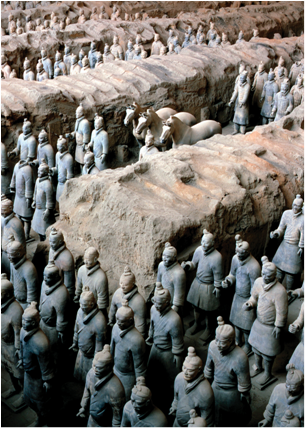
Figure 7-5 Army of the First Emperor of Qin in pits next to his burialmound, Lintong, China, Qin dynasty, ca. 210 BCE. Painted terracotta,average figure 5’ 10 7/8” high.
Qin Dynasty
•Excavations of this site began in 1974
•His burial mound is adjacent to thesepits of soldiers, and has yet to be dugup
•Researchers anticipate that the moundis full of treasure, including aminiature replica of China with riversof mercury and jeweled stars in theceilings…
20
Figure 7-5 Army of the First Emperor of Qin in pits next to his burialmound, Lintong, China, Qin dynasty, ca. 210 BCE. Painted terracotta,average figure 5’ 10 7/8” high.
Qin Dynasty
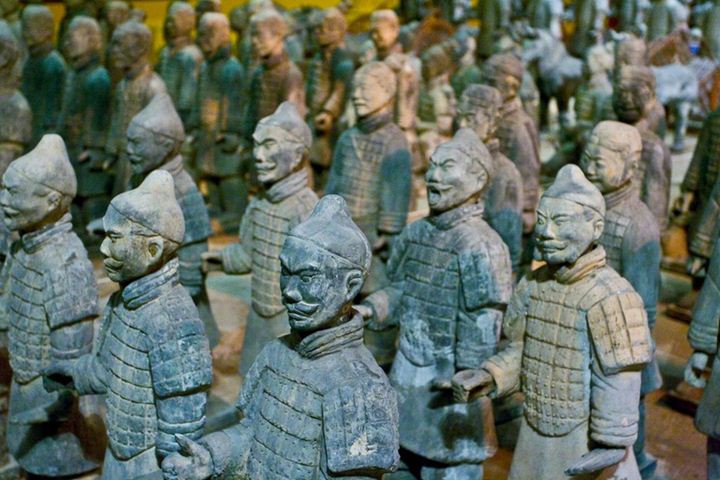
•These pits contain over 6000 life sizedceramic figures, each one is unique
•Also included bronze warriors,soldiers and chariots
•They served as the imperialbodyguard (right next to burialmound)
•Known as the “Terracotta Army”
21
Figure 7-5 Army of the First Emperor of Qin in pits next to his burialmound, Lintong, China, Qin dynasty, ca. 210 BCE. Painted terracotta,average figure 5’ 10 7/8” high.
Qin Dynasty
•The figures include cavalry, chariots,archers, lancers and hand to handfighters
•Lesser versions of this tomb have beendiscovered, suggesting this tomb mighthave served as a model
•Creating these sculptures requiredmuch organization:
22
Figure 7-5 Army of the First Emperor of Qin in pits next to his burialmound, Lintong, China, Qin dynasty, ca. 210 BCE. Painted terracotta,average figure 5’ 10 7/8” high.
Qin Dynasty
•Required a large number of sculptors,painters and huge kilns
•Did use some of the same molds, butalways in unique combinations
•Additional hand molding of thesculptures before firing also adds totheir individuality
•A brilliant balance of uniformity andindividuality
23
24
25
Han Dynasty
•206 – 220 CE
•Soon after Qin Shi Huangdi’s death, the people who had sufferedrevolted, assassinated his son, and founded the Han dynasty
•The borders of China expand, as do the trade routes… these are thetimes of the legendary Silk Road that led all the way to Rome
26
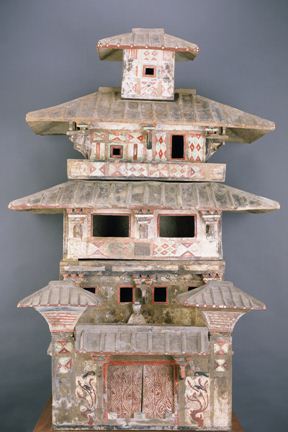
Figure 7-8 Model of a house, Han dynasty, first century CE. Paintedearthenware, 4’ 4” high. Nelson-Atkins Museum of Art, Kansas City.
Han Dynasty
•This is a beautiful example of a Hanminiature
•no actual remains of Han buildingsexist…
•models like this were found in graves
•Chinese raised beam construction
•walls not weight-bearing
27
Han Dynasty

28
Han Dynasty
Chinese raised beamconstruction:
•Beams are laid betweencolumns, decreasing thelength of the beams asthe structure rose
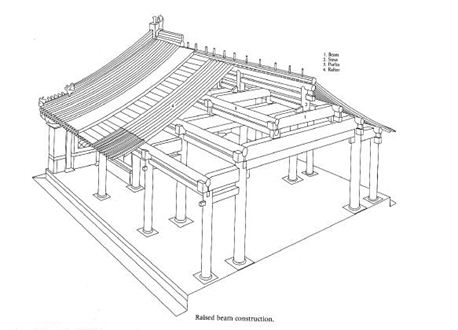
beam
29
Han Dynasty
Chinese raised beamconstruction:
•The beams supportvertical struts, which inturn support higherbeams and eventually thepurlins
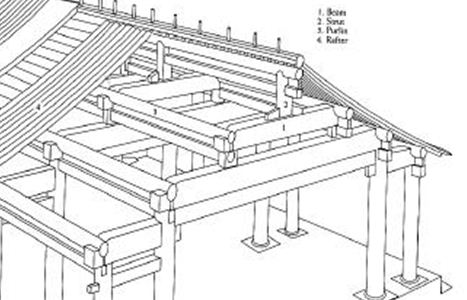
beam
purlin
strut
30
Han Dynasty
Chinese raised beamconstruction:
•The purlins run thelength of the building,carrying the roof’ssloping rafters
beam
purlin
strut
rafters
31
Han Dynasty
Chinese raised beamconstruction:
•The varying lengths ofthe cross beams and thevariously placed purlinscreates the curved profileof the rooflines…
•This style ofconstruction also allowedfor a broad overhang ofthe eaves, another typicalfeature of Chinesearchitecture
beam
purlin
strut
rafters
eaves
32
Period of Disunity
•220 – 589 CE
•Buddhism’s promise of hope beyond the troubles of this worldearned it a large audience in China during this time
•Buddhism also attracted intellectuals, which also helps itprosper…
•Buddhism never fully replaces Confucianism or Daoism
33
•The Buddha was a person born around 563 BCE
•Prince Siddhartha Gautama, later “The Enlightened One”
•meditated under a bodhi tree for years, became enlightened
•find peace through inner discipline
•suffering comes from craving sensory pleasures
•follow the Eightfold path to inner holiness
•cultivate the right views, aspirations, speech, conduct, livelihood,effort, mindfulness and concentration
•find Nirvana through meditation, discussion, humility and denial
•behavior determines one’s karma
•Buddha wandered and taught along the Ganges for ½ a century
•died around age 80
Buddhism Basics:
34
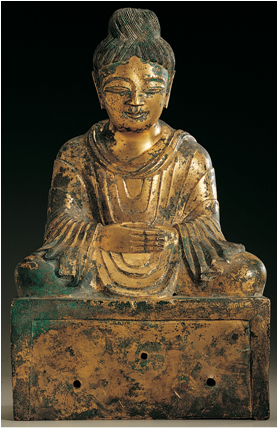
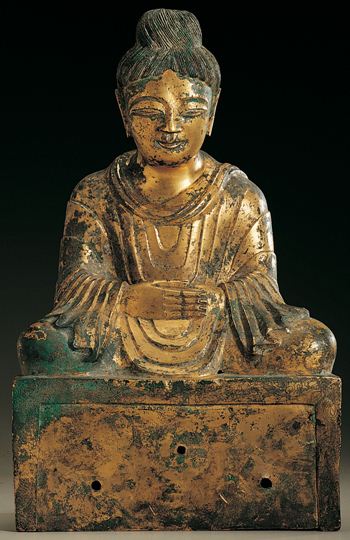
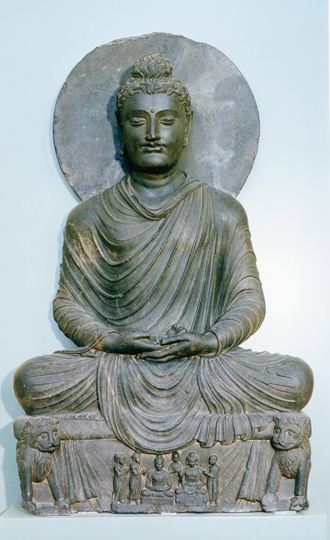
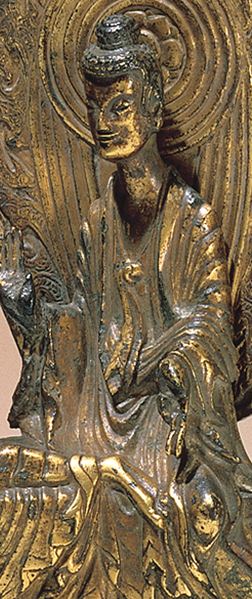
Figure 7-9 Shakyamuni Buddha, Zhao Dynasty, Period of Disunity, 338.Gilded bronze, 1’ 3 1/2” high. Asian Art Museum of San Francisco, SanFrancisco (Avery Brundage Collection).
Period of Disunity
•The earliest extant precisely datableChinese Buddhist image is this gildedbronze statuette (the date is inscribed)
•Shakyamuni Buddha = the historicalBuddha… the wise one of the Sakya tribe
•The earliest texts of the Buddha describehim as radiating golden light… hence thegilded bronze
•Gilded = gold, or gold-like…
35
Figure 7-9 Shakyamuni Buddha, Zhao Dynasty, Period of Disunity, 338.Gilded bronze, 1’ 3 1/2” high. Asian Art Museum of San Francisco, SanFrancisco (Avery Brundage Collection).
Period of Disunity
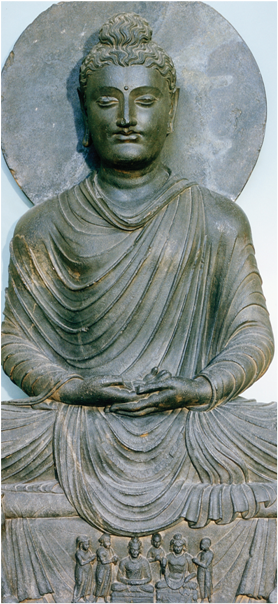
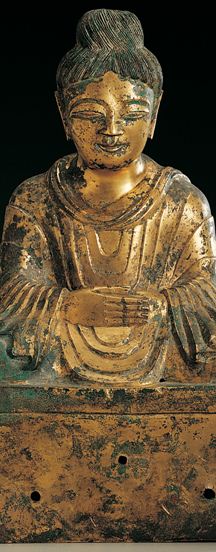
•This Buddha is very similar to the Buddhasdeveloped at Gandhara
•It recalls the South Asian models in its flat,relief like handling of the robe’s heavyconcentric folds
•It is also similar in including the ushnisha(cranial bump on his head---symbolizesenlightenment) and the yogic posture

36
37
Figure 7-9 Shakyamuni Buddha, Zhao Dynasty, Period of Disunity, 338.Gilded bronze, 1’ 3 1/2” high. Asian Art Museum of San Francisco, SanFrancisco (Avery Brundage Collection).
Period of Disunity
•So new was this icon in China, the artistmessed up the dhyana mudra, ormeditation gesture… the hands should beturned palms upward, with the thumbsbarely touching the torso…
38
Figure 7-10 GU KAIZHI, Lady Feng and the Bear, detail of Admonitionsof the Instructress to the Court Ladies, Period of Disunity, late fourthcentury. Handscroll, ink and colors on silk, 9 3/4” X 11’ 4 1/2”. BritishMuseum, London.
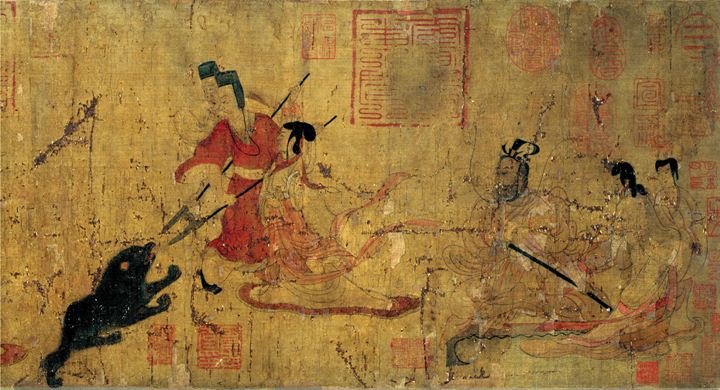
GU KAIZHI - China’s most famous early painter
39
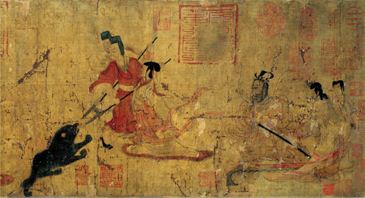
Figure 7-10 GU KAIZHI, Lady Feng and the Bear, detail of Admonitionsof the Instructress to the Court Ladies, Period of Disunity, late fourthcentury. Handscroll, ink and colors on silk, 9 3/4” X 11’ 4 1/2”. BritishMuseum, London.
Period of Disunity
•Chinese painting in general ison a much more intimate scalethan Western painting
•It is usually presented on scrollsand screens, best viewed by 1 or2 people at a time…
•Chinese are master of thebrush… ink painting andcalligraphy are honoredtraditions
40
Figure 7-10 GU KAIZHI, Lady Feng and the Bear, detail of Admonitionsof the Instructress to the Court Ladies, Period of Disunity, late fourthcentury. Handscroll, ink and colors on silk, 9 3/4” X 11’ 4 1/2”. BritishMuseum, London.
Period of Disunity
•Gu Kaizhi was a renownedcalligrapher, painter of courtportraits and a pioneer oflandscape painting…
•This scroll is not of his hand, but exemplifies the key elements of hisstyle… therefore we say the work is “attributed” to him… it wasmost likely actually executed by his students
•This is a section of a Chinese handscroll… this one reads from rightto left, with only a portion of the scroll revealed at a time withaccompanying text
41
Figure 7-10 GU KAIZHI, Lady Feng and the Bear, detail of Admonitionsof the Instructress to the Court Ladies, Period of Disunity, late fourthcentury. Handscroll, ink and colors on silk, 9 3/4” X 11’ 4 1/2”. BritishMuseum, London.
Period of Disunity
•Here, Lady Feng is saving herEmperor’s life… she is placingherself in between him and anattacking bear
•This is a perfect example of Confucian behavior
•As in many Chinese paintings, the background is minimal,emphasizing the narrative presented by the figures
•The poses, fluttering drapery and ribbons and facial expressions allcreate a sense of animation, or movement
42
Figure 7-10 GU KAIZHI, Lady Feng and the Bear, detail of Admonitionsof the Instructress to the Court Ladies, Period of Disunity, late fourthcentury. Handscroll, ink and colors on silk, 9 3/4” X 11’ 4 1/2”. BritishMuseum, London.
Period of Disunity
•The aesthetics and paintingideals of this time emphasize theimportance of expressing afigures inner vitality and spirit
•This was more valued thanreproducing surfaceappearances (which is theobsession of Western artists formost of the second millennium)
43
Figure 7-11 Shakyamuni and Prabhutaratna, Northern Wei dynasty, 518.Gilded bronze, 10 1/4” high. Musée Guimet, Paris.
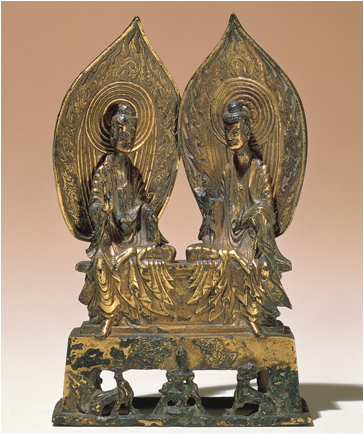
•mandorla – flamelike
nimbus behind each
•lalitasana pose – shows
relaxation
•it was made for private
devotion at home or an
offering at a temple
Period of Disunity
44
Figure 7-11 Shakyamuni and Prabhutaratna, Northern Wei dynasty, 518.Gilded bronze, 10 1/4” high. Musée Guimet, Paris.
•This representation of Buddhais very different stylistically fromthe Gandhara style Buddha
•It is the meeting of the twoBuddhas:
•Shakyamuni = the historicalBuddha
•Prabhutaranta = theenlightened Buddha
Period of Disunity
45
Figure 7-11 Shakyamuni and Prabhutaratna, Northern Wei dynasty, 518.Gilded bronze, 10 1/4” high. Musée Guimet, Paris.
•This scene is recounted in theLotus Sutra, en ecyclopediccollection of Buddhist thoughtand poetry
•Prab. Promised Shak. That hewould always be present whenLotus Law was being preached
•The meeting of the 2 Buddhassymbolizes the continuity ofBuddhist thought across the ages
Period of Disunity
46

47
48
Tang Dynasty
•618 – 906
•The short-lived Sui dynasty (581-618) succeeded inreuniting China, paving the way for the artistic brilliance ofthe Tang courts
•China expanded trade routes at this time, especiallyWestward
49
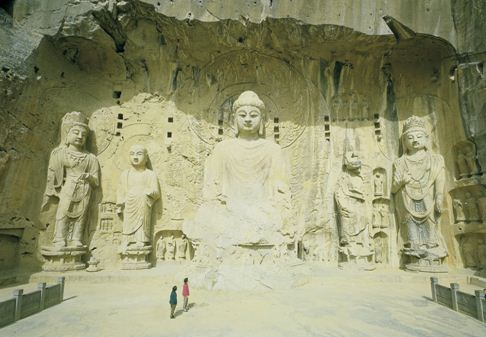
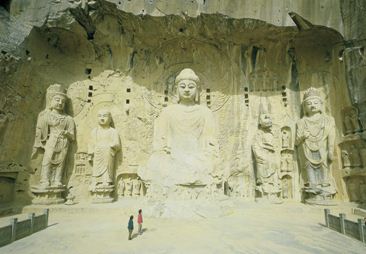
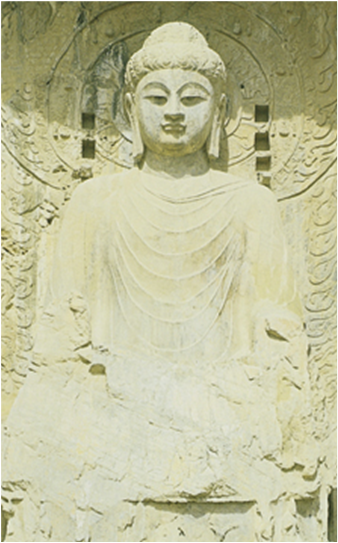
Figure 7-12 Vairocana Buddha, disciples, and bodhisattvas, LongmenCaves, Luoyang, China, Tang dynasty, completed 675. Buddha, approx. 44’high.
Tang Dynasty
•44 ft tall Buddha
•1352 caves
•97,000 statues
•3,600 inscriptions
•785 carved niches
•inspired by cave
temples of India
These caves took 2centuries to carve...
The Longmen Caves
50
Figure 7-12 Vairocana Buddha, disciples, and bodhisattvas, LongmenCaves, Luoyang, China, Tang dynasty, completed 675. Buddha, approx. 44’high.
Tang Dynasty
The Longmen Caves
•There is aninscription indicatingthat the Empress WuZetian used much ofher private wealth tocomplete the project
•Wu Zetian ruledwhen her husband,Gaozong, died…(683-705)
51
Figure 7-12 Vairocana Buddha, disciples, and bodhisattvas, LongmenCaves, Luoyang, China, Tang dynasty, completed 675. Buddha, approx. 44’high.
Tang Dynasty
The Longmen Caves
•Vairocana Buddha is the“cosmic Buddha”
•The Buddha of boundless spaceand time
•He is flanked by monks andbodhisattvas
•The artist suppressed surfacedetail in the interest ofmonumental simplicity
52
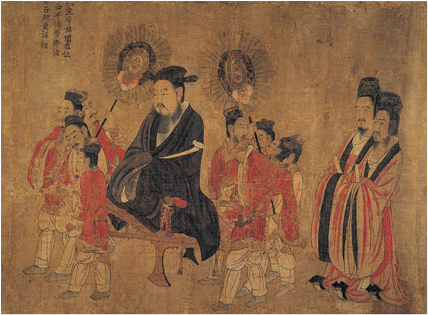
Figure 7-15 Attributed to YAN LIBEN, Emperor Xuan and attendants,detail of The Thirteen Emperors, Tang dynasty, ca. 650. Handscroll, inkand colors on silk, detail: 1‘ 8 1/4” X 1’ 5 1/2”; entire scroll, 17’ 5” long.Museum of Fine Arts, Boston.

Tang Dynasty
•Many art historians callthe Tang dynasty thegolden age of Chinesefigure painting
•This is a masterpiece ofline drawing and colorwashes
•This handscroll depicts 13rulers from the Han to Suidynasties
53
Figure 7-15 Attributed to YAN LIBEN, Emperor Xuan and attendants,detail of The Thirteen Emperors, Tang dynasty, ca. 650. Handscroll, inkand colors on silk, detail: 1‘ 8 1/4” X 1’ 5 1/2”; entire scroll, 17’ 5” long.Museum of Fine Arts, Boston.
Tang Dynasty
•the purpose of the scroll
was to portray the men as
exemplars of moral and
political virtue (very
Confucian)
•ceremonial fans indicate his
imperial status
•this is a detail of the entire scroll-depicting one ruler with attendants
•How else does the Emperor stand out?
54
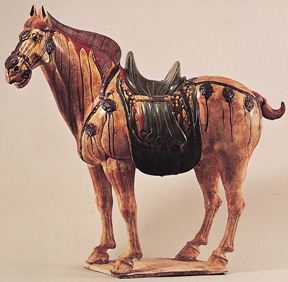
Figure 7-17 Neighing Horse, Tang dynasty, eighth to ninth century.Glazed earthenware, 1’ 8” high. Victoria and Albert Museum, London.
Tang Dynasty
•The horse was just as esteemed subjectmatter as the figure or
landscape
•thick neck, small head = steed ofnobility
•super fancy saddle
•colorful glazes streamed down
for decoration (especially greens and red-oranges) = this is distinctly “Tang”
55
Northern Song Dynasty
•Northern Song Period (960 – 1127) the country consolidates onceagain
•Political appointments were made on the basis of civil serviceexaminations, not high birth…
•Education becomes more important than social class
•Technology: the compass for sea navigation, printing withmovable type, paper money and gunpowder (most advancedculture in the world at this time)
56
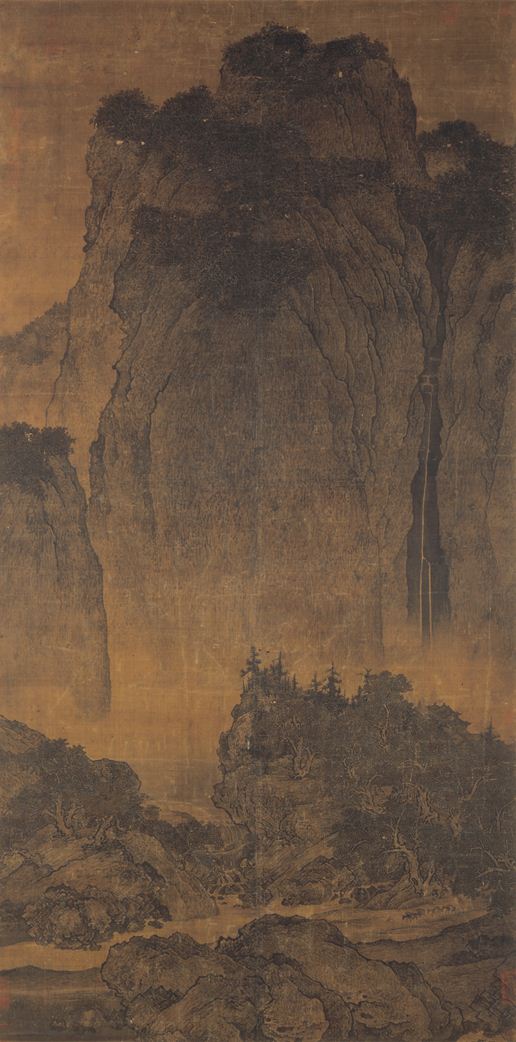
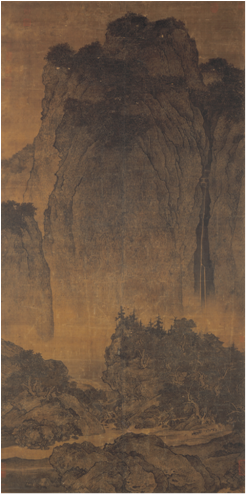
Figure 7-18 FAN KUAN, Travelers among Mountainsand Streams, Northern Song period, early eleventhcentury. Hanging scroll, ink and colors on silk, 6’ 7 1/4”X 3’ 4 1/4”. National Palace Museum, Taibei.
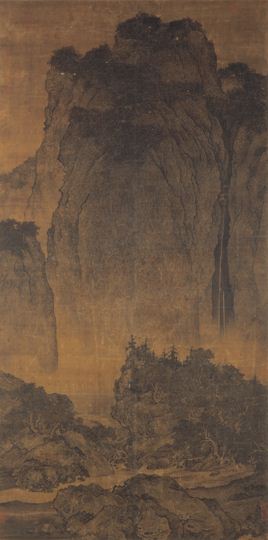
•light, shade, distance and texture
•a great time for landscape
•the gigantic mountains and tiny
Figures = very Daoist
•to really appreciate this you have to
not only see the big picture, but also
all the strokes
Northern Song
57
Figure 7-18 FAN KUAN, Travelers among Mountainsand Streams, Northern Song period, early eleventhcentury. Hanging scroll, ink and colors on silk, 6’ 7 1/4”X 3’ 4 1/4”. National Palace Museum, Taibei.
Northern Song
•Can you find evidence of the travelers?
58
Figure 7-18 FAN KUAN, Travelers among Mountainsand Streams, Northern Song period, early eleventhcentury. Hanging scroll, ink and colors on silk, 6’ 7 1/4”X 3’ 4 1/4”. National Palace Museum, Taibei.
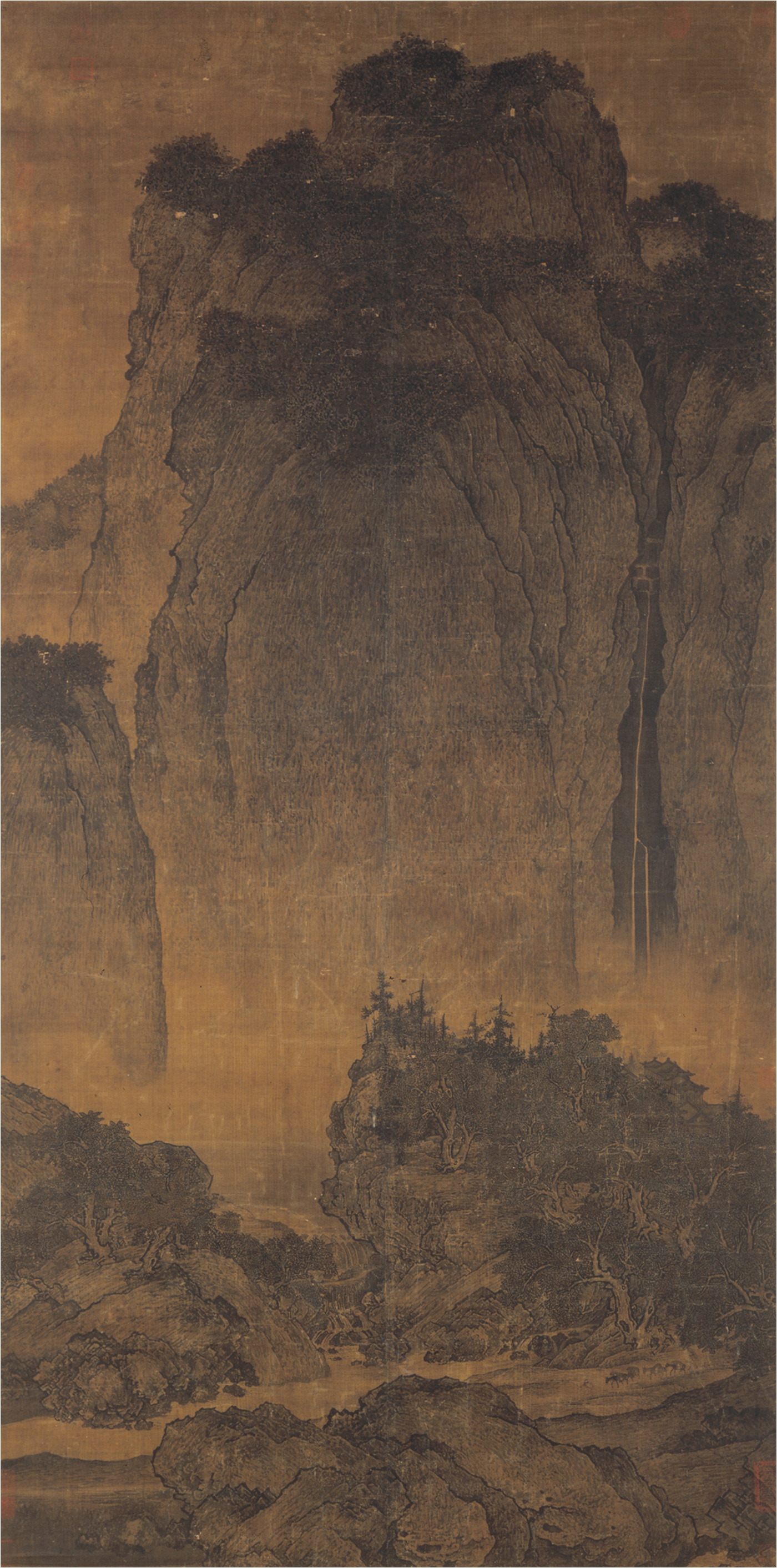
•Can you find evidence of the travelers?
Northern Song
59
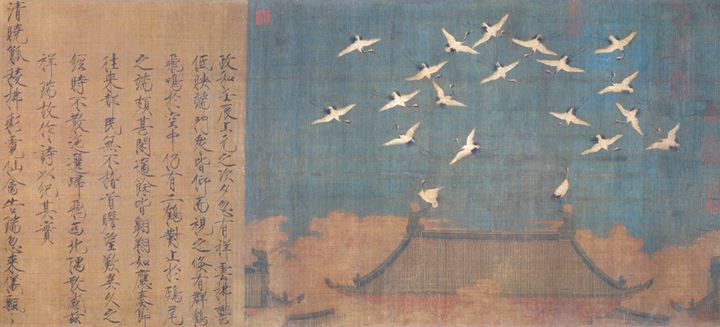
Figure 7-19 Attributed to HUIZONG, Auspicious Cranes, section of ahandscroll, Northern Song period, 1112. Ink and colors on silk, 1’ 8 1/8” X4’ 6 3/8”. Liaoning Provincial Museum, Shenyang.
Northern Song
60
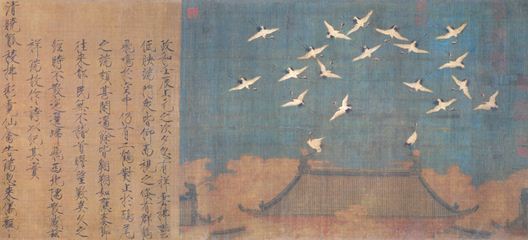
Figure 7-19 Attributed to HUIZONG, Auspicious Cranes, section of ahandscroll, Northern Song period, 1112. Ink and colors on silk, 1’ 8 1/8” X4’ 6 3/8”. Liaoning Provincial Museum, Shenyang.
Northern Song
This is actually a propaganda piece commemorating the appearanceof 20 white cranes at the palace gates during a festival
The cranes were an auspicious sign, proof that Heaven approved…
Perfection ofpoetry,calligraphy andpainting
61
Figure 7-20 Meiping vase, from Xiuwi, China, Northern Song period,twelfth century. Stoneware, Cizhou type, with sgraffito decoration, 1’ 71/2” high. Asian Art Museum of San Francisco, San Francisco (AveryBrundage Collection).
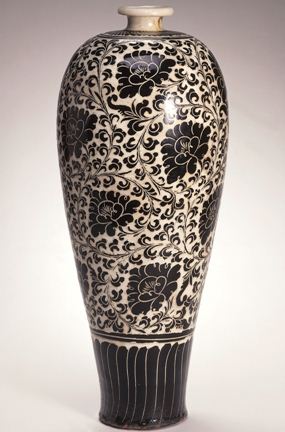
Northern Song
•elegant contour (outline)
•embracing vine design
•“high-shouldered” form
•sgraffitto – incising technique
•Meiping = vase for plum blossoms
62
Figure 7-20 Meiping vase, from Xiuwi, China, Northern Song period,twelfth century. Stoneware, Cizhou type, with sgraffito decoration, 1’ 71/2” high. Asian Art Museum of San Francisco, San Francisco (AveryBrundage Collection).
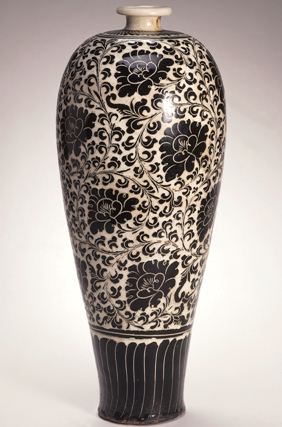
shoulder
lip
neck
foot
Pot parts
waist
63
Figure 7-21 Foguang Si Pagoda,Yingxian, China, Liao Dynasty,1056.
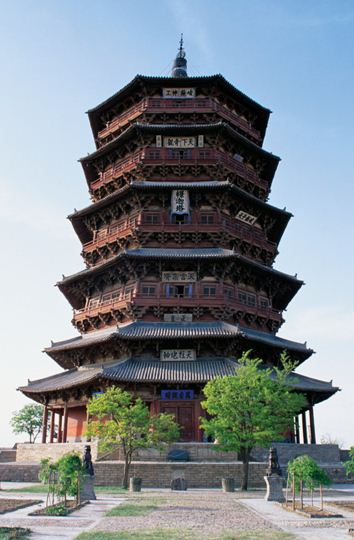
Northern Song
•pagodas – towers
•this one is made of wood
•216 feet tall
•Raised Beam Construction
•holds sacred images of Buddha
64
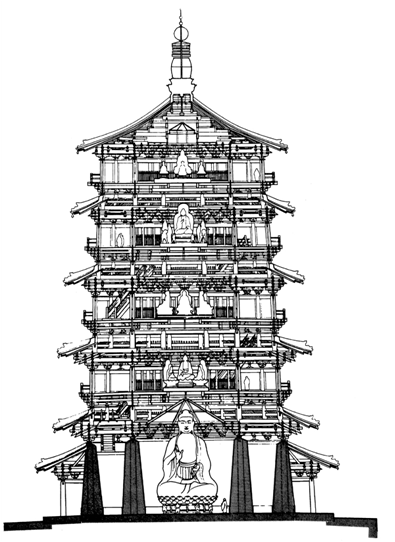
cross section
pagoda
65
Southern Song Dynasty
•1127 – 1279
•Court sponsorship of painting continues in this dynasty
•The Ma family was especially revered by the Southern Songdynasty, painting for the court for several generations
•The Emperors would add their poetry right onto the paintings
66
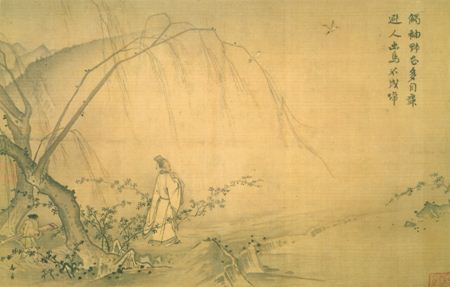
Figure 7-23 MA YUAN, On a Mountain Path in Spring, SouthernSong period, early thirteenth century. Album leaf, ink and colors onsilk, 10 3/4” X 17”. National Palace Museum, Taibei.
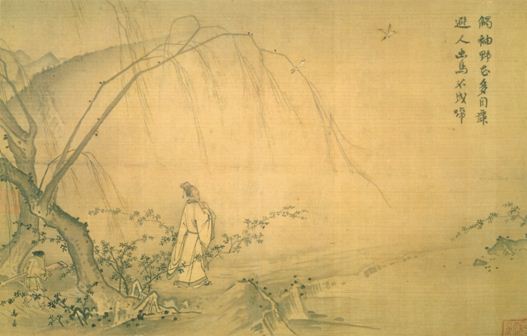
Brushed by his sleeves, wild flowers dance in the wind
Fleeing from him, hidden birds cut short their song - Ningzong
Southern Song
67
Southern Song
Northern Song
68
Figure 7-24 ZHOU JICHANG, Arhats GivingAlms to Beggars, Southern Song period, 1184.Ink and colors on silk, 3’ 8” X 1’ 9”. Museum ofFine Arts, Boston.
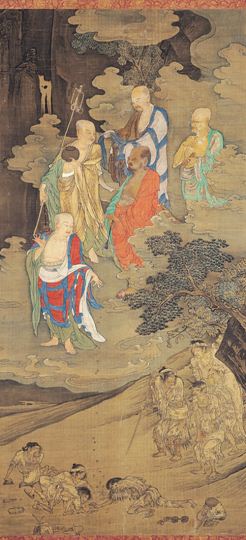
Southern Song
•Arhats – enlightened disciples of Buddha
who have attained nirvana by suppressing
all earthly desire
•How does the artist establish status?
69
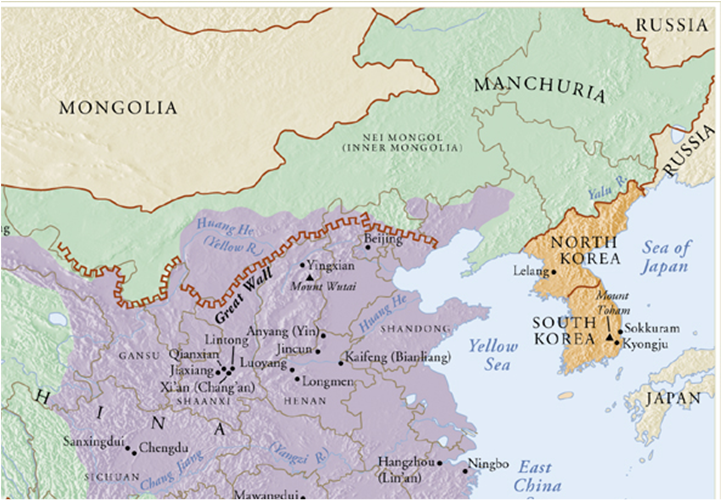
Korea’s location is key to understanding its artistic relationship toChina and Japan
70
Korea
•Ethnically, Koreans are related to the people of eastern Siberia andMongolia, as well as the Japanese
•In the early centuries Koreans used Chinese characters to writeKorean words, but later they created their own phonetic alphabet(changes in the 15th C)
•Though much Korean art is frequently based on Chinese models, itis not merely derivative, but is a unique blending of styles
•Korea also offers the world ancient treasures that are completelyunique to their culture
71
Three Kingdoms Period (57 BCE – 688 CE)
•Pottery producing cultures emerge in Korea during Neolithic timesaround the 8th to 7th C BCE
•Korean Bronze Age was around 2nd to 1st C BCE
•Koreans learned bronze technology from China
•About 100 BCE (Han Dynasty) the Chinese establish outposts inKorea, the most important being Lelang
•By the middle of the century, 3 native Kingdoms (Koguryo,Paekche, and Silla) gain full control of the peninsula
Korea
72
Three Kingdoms Period (57 BCE – 688 CE)
•The Three Kingdoms reigned for more than 7 centuries
•During the Three Kingdoms era Korea had much contact withChina and Japan
•Buddhism was introduced to Korea from China in the 4th C CE
•Koreans then introduced Buddhism to Japan in the 6th C CE
Korea
73
Korea:
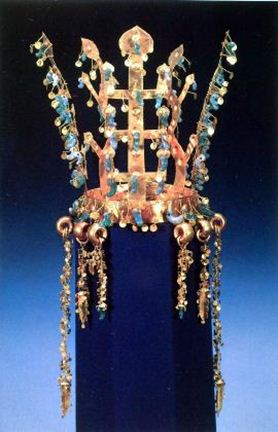
Crown, from north mound of tomb 98 at Hwangnamdong, near Kyongju,Korea, Silla kingdom, 5th to 6th C. Gold, 10 and ¾ “ high. KyongjuNational Museum, Kyongju.
•These gorgeous crowns are uniquelyKorean
•Kyongju’s ancient name is Kumsong,meaning city of gold
•The band, uprights and spangles werecut from sheet gold and embossed alongthe edges
•Gold rivets and wires hold it altogether
Gold Crowns in Silla Tombs:
74
Korea:
Crown, from north mound of tomb 98 at Hwangnamdong, near Kyongju,Korea, Silla kingdom, 5th to 6th C. Gold, 10 and ¾ “ high. KyongjuNational Museum, Kyongju.
•It is also embellished with coma-shapedpieces of jade
•Archaeologists interpret the uprights asstylized tree and antler forms believed tosymbolize life and supernatural power
•These treasures have survived because ofthe style of tombs the Silla used
•The tombs were inaccessible, with noentries or corridors
Gold Crowns in Silla Tombs:
75
Korea:
Crown, from north mound of tomb 98 at Hwangnamdong, near Kyongju,Korea, Silla kingdom, 5th to 6th C. Gold, 10 and ¾ “ high. KyongjuNational Museum, Kyongju.
•The tombs were incredibly deep pitslined with wood and sealed with clay
•Then huge boulders were placed on topand it was all covered with massive pilesof dirt (mounds)
•When the Silla kings adopted Buddhismin 528 CE, this led to the end of thispractice of burying kings with gold inelaborate tombs
Gold Crowns in Silla Tombs:
76
Unified Silla Kingdom (688-935)
•With the help of China, the Silla conquer the Koguryo and Paekchein 688, unifying Korea for the first time
•This era is roughly contemporary with Tang dynasty China
•Many consider the Unified Silla Kingdom as Korea’s golden age inart
Korea
77
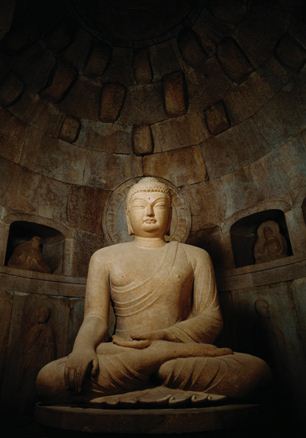
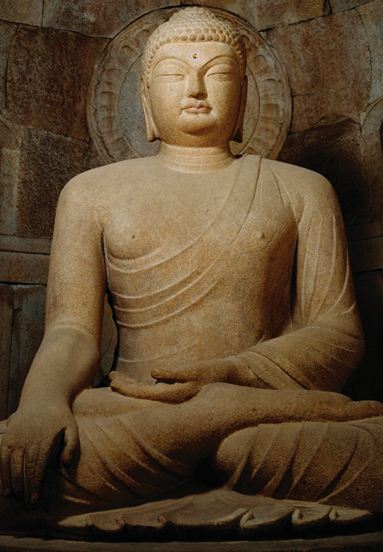
Figure 7-27 Shakyamuni Buddha, at entrance to cave temple, Sokkuram,Korea, Great Silla, 751–774. Granite, approx. 11’ high.
Korea – Silla Kingdom
•The Silla rulers embraced Buddhismas both a source of religiousenlightenment and as a protectiveforce
•The Buddhist temples were notmerely places of worship, but also asupernatural defense against externalthreats
•Unfortunately, none of these templeshave survived
78
Figure 7-27 Shakyamuni Buddha, at entrance to cave temple, Sokkuram,Korea, Great Silla, 751–774. Granite, approx. 11’ high.
Korea – Silla Kingdom
•Fortunately, this small, private templeremains
•The main rotunda (circular areaunder the dome) is only about 21 feetacross
•The structure was not carved, butassembled… hundreds of differentsized pieces attached with stone rivetsinstead of mortar
79
Figure 7-27 Shakyamuni Buddha, at entrance to cave temple, Sokkuram,Korea, Great Silla, 751–774. Granite, approx. 11’ high.
Korea – Silla Kingdom
•Sculpted Bodhisattvas, arhats andguardians line the lower row on thewall
•Above, 10 niches contain miniaturestatues of seated bodhisattvas andbelievers
•All the figures face the ShakyamuniBuddha which dominates the chamber,facing the entryway
80
Figure 7-27 Shakyamuni Buddha, at entrance to cave temple, Sokkuram,Korea, Great Silla, 751–774. Granite, approx. 11’ high.
Korea – Silla Kingdom
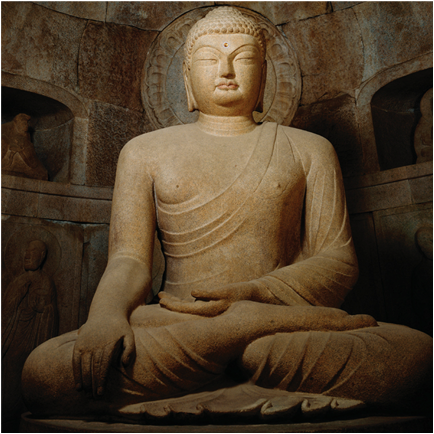
•The Buddha is carved from a singlepiece of granite
•Buddha is reaching towards theground, a gesture symbolic of hisrealization of his enlightenment
•The full-faced Buddha is stylisticallysimilar to the full figured sculpture ofthe Tang dynasty… the robe is alsosimilar to Tang style drapery…
81
Figure 7-27 Shakyamuni Buddha, at entrance to cave temple, Sokkuram,Korea, Great Silla, 751–774. Granite, approx. 11’ high.
Korea – Silla Kingdom
•The broad shoulders andharmonious proportionsare without closeprecedents (not Chinese…)
•It is regarded of one of thefinest Buddha sculpturesof East Asia
82
83
Koryo Dynasty (935 – 1231)
•In the 9th C, the old kingdoms began to re-emerge, and the Koryo(from Koguryo) eventually take control
•In 1231 the Mongols pushed into Korea
•After 30 years of war, the Koryo submitted to forming an alliancewith the Mongols who will eventually conquer all of China
Korea
84
Korea: Celadon Ware
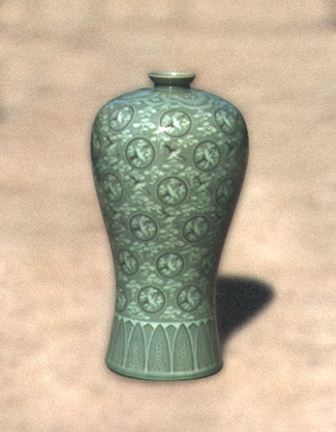
Maebyong vase, Koryo period, ca. 918-1000. Celadon with inlaiddecoration, 1’4 ½ “ tall. Kansong Art Museum, Seoul.
•Celadon wares are characterized byhighly translucent iron-pigmentedglazes, fired in an oxygen-deprivedkiln to become gray, pale blue, palegreen, or brownish olive
•Incised or engraved designs alterthe thickness of the glaze to produceelegant tonal variations
85
Korea: Celadon Ware
Maebyong vase, Koryo period, ca. 918-1000. Celadon with inlaiddecoration, 1’4 ½ “ tall. Kansong Art Museum, Seoul.
•Here we see the delicate motif offlying cranes…
•Some cranes are flying down, whilesome are in roundels (circularfames) are flying up
•Variation in the spacing of themotifs show the potter’s sure senseof the dynamic relationship betweenornamentation and ceramic volume
86
Korea: Celadon Ware
Maebyong vase, Koryo period, ca. 918-1000. Celadon with inlaiddecoration, 1’4 ½ “ tall. Kansong Art Museum, Seoul.
•Curving forms and ample volumeswere other characteristic features ofthe Koryo ceramists
•They tend to have a:
•Curled lip
•Short neck
•Rounded shoulder
•Constricted waist
•Slight flair to the foot
87
Korea: Celadon Ware
Maebyong vase, Koryo period, ca. 918-1000. Celadon with inlaiddecoration, 1’4 ½ “ tall. Kansong Art Museum, Seoul.
•Many had lids and were used forstoring wine, especially expensivewines
•“Maebyong” comes from theChinese mei-ping (vase for plumblossoms)…
•These were prized artforms madefor Koryo royalty